


Interoperable Healthcare Information Technology (Health IT) Systems Market
Market Size and Growth
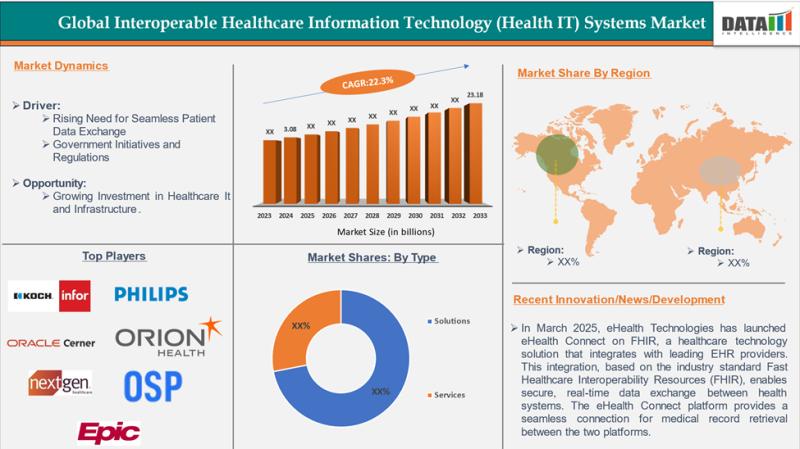
Global Interoperable Healthcare Information Technology (Health IT) Systems Market reached US$ 3.08 billion in 2024 and is expected to reach US$ 23.18 billion by 2033, growing at a CAGR of 22.3% during the forecast period 2025-2033.
Get a Free Sample PDF Of This Report (Get Higher Priority for Corporate Email ID):- https://www.datamintelligence.com/download-sample/interoperable-healthcare-information-technology-systems-market?sb
Key Development:
United States: Recent Industry Developments
✅ In November 2025, NTT DATA Healthcare launched a cross-institutional interoperability service using HL7 FHIR and IHE standards to connect clinics, hospitals, and public health agencies. The platform enables secure, real-time exchange of patient records across care settings. It strengthens coordinated care delivery and data continuity nationwide.
✅ In September 2025, Health Catalyst launched an advanced healthcare interoperability suite focused on data orchestration, normalization, and clinical analytics. The solution integrates multi-source clinical and administrative data into unified workflows. It supports value-based care and improved clinical decision-making.
✅ In September 2025, Epic Systems previewed enhanced interoperability capabilities, including expanded APIs and developer tools. The update simplifies bi-directional data exchange between EHRs, third-party applications, and patient platforms. It improves connectivity across provider networks and digital health ecosystems.
✅ In August 2025, Redox introduced a unified API gateway enabling real-time, bi-directional data exchange between legacy EHRs, digital health applications, and analytics platforms. The launch improves scalability and reduces integration complexity. It accelerates interoperable healthcare infrastructure adoption.
Buy Now & Unlock 360° Market Intelligence: https://www.datamintelligence.com/buy-now-page?report=interoperable-healthcare-information-technology-systems-market
Japan: Recent Industry Developments
✅ In November 2025, NTT DATA Healthcare launched a FHIR-based interoperability service linking hospitals, clinics, and regional health authorities. The system enables standardized data sharing across institutions. It strengthens regional care coordination and continuity of patient records.
✅ In October 2025, Fujifilm Healthcare Japan announced a strategic investment to expand FHIR-based integration platforms for electronic medical records and AI-enabled diagnostic systems. The initiative focuses on seamless data flow across clinical environments. It supports Japan’s digital healthcare transformation efforts.
✅ In September 2025, Hitachi Healthcare Systems launched a national-scale healthcare data integration framework using standardized APIs. The platform supports government-led patient data sharing initiatives. It enhances interoperability across public and private healthcare providers.
✅ In August 2025, NEC Corporation introduced a privacy-centric interoperability platform combining FHIR standards with advanced consent management. The solution enables secure sharing of patient data across healthcare organizations. It strengthens data governance and patient trust in interoperable systems.
Speak to Our Analyst and Get Customization in the report as per your requirements: https://www.datamintelligence.com/customize/interoperable-healthcare-information-technology-systems-market?sb
Recent Mergers and Acquisition:
United States: Recent M&A in Interoperable Healthcare IT
✅ In November 2025, a US-based healthcare data platform completed a strategic acquisition of a data management and analytics provider to expand its integrated solutions for payers and providers. The acquisition strengthens cross-system data sharing and unified clinical workflows, enhancing interoperability across care networks.
✅ In October 2025, a major healthcare interoperability solutions firm was acquired by a larger software group to enhance integrated data exchange capabilities across EHR systems. This supports real-time clinical and administrative interoperability across health systems.
✅ In September 2025, Waystar expanded its healthcare IT portfolio by acquiring an AI-driven documentation and reimbursement automation company. The deal enables richer integration of administrative and clinical data workflows that support interoperability initiatives.
✅ In August 2025, Bain Capital completed the acquisition of a healthcare software company providing advanced solutions for insurers and care networks. This reinforces interoperability-ready platforms for claims, member data, and care coordination.
Key Players:
=> Infor (Koch Industries Inc), Koninklijke Philips N.V., Cerner Corporation (Oracle Health), Orion Health Group Limited, NXGN Management, LLC (NextGen Healthcare), OSP Labs, Epic Systems Corporation, ViSolve Inc, InterSystems Corporation, and iNTERFACEWARE Inc among others.
Key Segments:
By Type
Solutions dominate the market with 60% share, driven by increasing adoption of healthcare IT platforms for patient data management, diagnostics, and clinical workflows. Services account for 40%, supported by the growing demand for consulting, implementation, maintenance, and managed interoperability solutions in hospitals and ambulatory care centers.
By Level of Interoperability
Semantic Interoperability leads with 45% share, fueled by the need for standardized data exchange, accurate clinical decision-making, and integration across multiple healthcare systems. Structural Interoperability accounts for 35%, supported by adoption of common data formats, messaging standards, and protocol compliance. Foundational Interoperability holds 20%, driven by basic data sharing requirements and emerging adoption in small healthcare facilities.
By Deployment Method
Cloud-Based deployment dominates with 55% share, driven by scalability, cost-effectiveness, and remote accessibility of healthcare data. On-Premise solutions account for 45%, supported by healthcare organizations prioritizing data security, regulatory compliance, and legacy system integration.
By Application
Diagnosis leads the market with 50% share, driven by the need for accurate and rapid patient assessments across hospitals and specialty clinics. Treatment accounts for 35%, supported by adoption of interoperable platforms to optimize therapy plans, monitor patient outcomes, and enhance care delivery. Others hold 15%, including administrative management, billing, and operational workflow optimization.
By End User
Hospitals hold the largest share at 60%, fueled by high patient volumes, advanced IT infrastructure, and regulatory requirements for integrated healthcare solutions. Ambulatory Surgical Centers account for 25%, driven by outpatient care growth, increasing adoption of digital solutions, and cost-effective interoperability platforms. Others represent 15%, including diagnostic centers, specialty clinics, and small healthcare providers adopting tailored solutions.
By Region
North America – 40% Share
North America leads the market with 40%, driven by advanced healthcare IT adoption, robust regulatory frameworks, growing patient data management needs, and strong presence of key interoperability solution providers in the U.S. and Canada.
Europe – 25% Share
Europe holds 25%, supported by increasing digital health initiatives, healthcare modernization programs, and regulatory incentives across Germany, U.K., France, and Italy.
Asia-Pacific – 20% Share
Asia-Pacific accounts for 20%, fueled by rapid digital transformation in healthcare, government initiatives promoting electronic health records, and increasing investments in smart hospital infrastructure in China, India, Japan, and Australia.
Latin America – 10% Share
Latin America represents 10%, driven by expanding healthcare IT adoption, government-backed interoperability projects, and rising investments in hospitals and outpatient care facilities in Brazil and Argentina.
Middle East & Africa – 5% Share
Middle East & Africa account for 5%, supported by growing healthcare infrastructure, adoption of modern IT platforms, and increasing private-sector investment in healthcare interoperability solutions.
FAQ
What is the current size of the Interoperable Healthcare Information Technology (Health IT) Systems Market?
A: In 2024, the Interoperable Healthcare Information Technology (Health IT) Systems Market was valued at US$ 3.08 billion, reflecting its strong industry presence.
Q2: How large is the Interoperable Healthcare Information Technology (Health IT) Systems Market expected to be by 2033?
A: By 2033, industry forecasts suggest the Interoperable Healthcare Information Technology (Health IT) Systems Market will grow to around US$ 23.18 billion, demonstrating significant expansion.
Q3: What is the growth rate of the Interoperable Healthcare Information Technology (Health IT) Systems Market?
A: The market is projected to expand at a compound annual growth rate (CAGR) of 22.3% during the forecast period from 2025 to 2033.
Unlock 360° Market Intelligence with DataM Subscription Services: https://www.datamintelligence.com/reports-subscription?sb
Power your decisions with real-time competitor tracking, strategic forecasts, and global investment insights all in one place.
✅ Competitive Landscape
✅ Sustainability Impact Analysis
✅ KOL / Stakeholder Insights
✅ Unmet Needs & Positioning, Pricing & Market Access Snapshots
✅ Market Volatility & Emerging Risks Analysis
✅ Quarterly Industry Report Updated
✅ Live Market & Pricing Trends
✅ Import-Export Data Monitoring
Have a look at our Subscription Dashboard: https://www.youtube.com/watch?v=x5oEiqEqTWg?sb
Contact Us –
Company Name: DataM Intelligence
Contact Person: Sai Kiran
Email: Sai.k@datamintelligence.com
Phone: +1 877 441 4866
Website: https://www.datamintelligence.com
About Us –
DataM Intelligence is a Market Research and Consulting firm that provides end-to-end business solutions to organizations from Research to Consulting. We, at DataM Intelligence, leverage our top trademark trends, insights and developments to emancipate swift and astute solutions to clients like you. We encompass a multitude of syndicate reports and customized reports with a robust methodology.
Our research database features countless statistics and in-depth analyses across a wide range of 6300+ reports in 40+ domains creating business solutions for more than 200+ companies across 50+ countries; catering to the key business research needs that influence the growth trajectory of our vast clientele.
This release was published on openPR.
link