


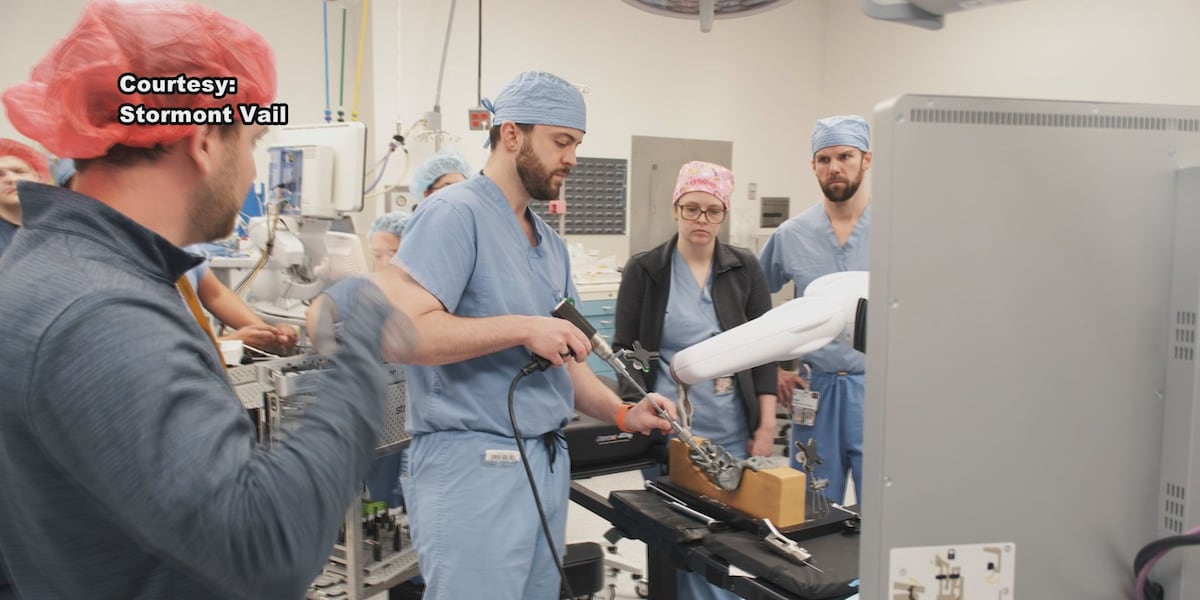
TOPEKA, Kan. (WIBW) – New advances in artificial intelligence and robotic technology are making spine surgeries better and safer for patients.
The latest generation, Mako Spine, was used in Topeka for the first time this week.
Stormont Vail neurosurgeon Dr. Chad Tuchek says accuracy is especially important when it comes to spinal procedures.
“Spine surgery can be as simple as putting in a couple screws all the way to completely disarticulating someone’s spine and putting it back together,” he said. “Along the way we are putting in often times large implants into small, tight spaces right around tiny little nerves. Doing that safely is the whole point of using things like navigation and robotic systems.”
Dr. Tuchek says complications can range from pain and weakness, to paralysis or loss of bowel and bladder control.
Robotics are a big step forward. While many facilities use Mako’s system for hips and knees, this week, Stormont became one of the first to use Mako Spine.
Dr. Tuchek said the system allows surgeons to operate through incisions only three to four inches long, rather than 12 inches or more.
“Doing the same old-school surgery where we open someone’s back (with a long cut) might be effective, but you can imagine the recovery time of that can be 3, 6 or 12 months, and if you’re on the older side and less healthy side, you might not recover as well as someone who’s younger or in better shape would,” Dr. Tuchek said.
The robot is coupled with advanced artificial intelligence. Surgeons use intraoperative 3D scanners to visualize the spine and craft a plan for the robot to help them execute.
“When you’re planning 1 or 2 screws, sure you can make that align, but when we’re talking about 10 or 20, it can be very challenging to line everything up in order to make the rods that we place ore the other hardware actually fit in perfectly,” Dr. Tuchek said. “At end of day, patients aren’t better if we don’t maintain both neuro-decompression and spinal good alignment.”
Dr. Tuchek says the basic techniques are the same, but technology is taking them into the future.
“What that really means to patients is less pain, less time in the hospital, and better short-term and long-term outcomes,” he said.
The Mako Spine system is currently used for lumbar spinal fusions. They’re exploring how it could be used in other areas of the spine in the future.
Copyright 2025 WIBW. All rights reserved.
link